Sara Blakely is the queen of the undergarment industry. Without any experience in retail or business and very little cash, she founded Spanx when she was only 29 years old.
How did she do it? Was it her parents’ kind words and gentle encouragement? Not exactly. As highlighted in an article at 99U, Blakely’s parents had an unconventional approach to child rearing:
The New York-based dermatologist and skincare brand founder understands the alchemy of beauty. He discusses the restorative powers of love and a good Netflix binge.
Botticelli’s Birth of Venus? Monet’s Water Lilies? Munch’s The Scream? Vermeer’s Girl with a Pearl Earring?
It turns out none of the above. Two digital artists, Vitalyl Komar and Alex Melamid, conducted a number of polls to explore artistic preferences of people in ten countries. Participants were asked detailed questions about what type of picture they most like to look at, whether they prefer landscapes or interiors scenes, favorite colors, what kinds of animals they like, what sorts of people they enjoy seeing depicted, whether they prefer them clothed or nude, young or old, famous or ordinary, bathing or sitting and so on.
The results across countries were surprisingly uniform: the most-wanted painting was a landscape with a mountain, water, wild animals, a tree, some people and strong blue colors.
Philosopher Denis Dutton argues in his book The Art Instinct that the universal appeal of landscapes with these elements can be explained by evolution. When our ancestors had to search for food and safety, an open space with water and a climbable tree would have represented safe, peaceful and prosperous environment. In other words, he believes our emotional response to landscape works is part of our survival instinct. We evolved to appreciate art and see the beauty in landscapes because it helped us survive.
As George Bernard Shaw says:
Without art, the crudeness of the world would make reality unbearable.
A house is just a place to keep your stuff while you go out and get more stuff.
Nate Berkus couldn’t disagree more.
In his book, The Things That Matter, Berkus reflects on whatreally mattersin life. He writes about the places, the people and events that have shaped him and what he values most. His home is a reflection and expression of who he is. Every object tells a story, every piece belongs there. He laments the collection of meaningless stuff and challenges us to think carefully about the things we choose to surround ourselves with and the environment we live in.
Captivating photographs paired with Berkus’ engaging voice create a beautiful book, part memoir, part design guide, 100% inspiration.
Our biographies are not always written with a pen. If we let them, our homes also tell the stories of our lives.
We can’t escape who we are, and what we love, and the truth is, it’s a mistake even to try.
So donate the clutter and honor the treasures that matter most.
The last ten years of Henri Matisse’s were far from what most of us would think of as joyful. His marriage was over, he was diagnosed with cancer and underwent a number of painful surgeries, and his beloved daughter was imprisoned and tortured by the Gestapo for aiding the French Resistance. Who could have blamed him for calling it quits and sinking into deep despair? And yet, during this dark time he created the most electrifyingly joyful work of his career.
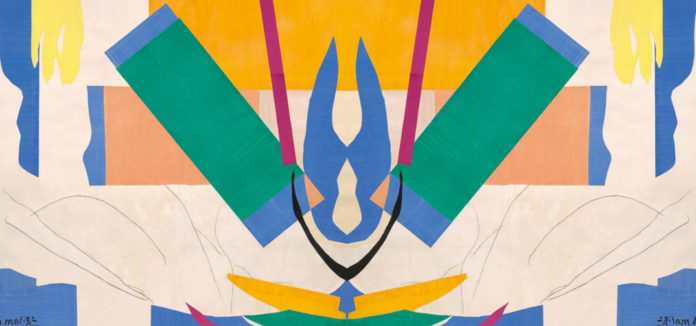
Confined to a wheelchair and crippled by pain, Matisse never stopped working. In fact, rather than a period of decline, it became what Matisse described as a “seconde vie.” He transformed the darkness into an intensely vibrant and productive period, creating “cut-outs” –the cut paper collages he described as “painting with scissors.” Unlike actual painting, painting with scissors could be done from his wheelchair or bed.
Matisse once famously said, “Work cures everything,” and one cannot help but consider the therapeutic value of the cut-outs for Matisse. Studies show that meaningful work and a sense of purpose—a reason to get out of bed in the morning—are linked with longevity and life satisfaction. Because of pain and physical limitations, Matisse often couldn’t get out of bed in the morning so he rose to the challenge and worked from his bedside instead:
You see as I am obliged to remain often in bed because of the state of my health, I have made a little garden all around me where I can walk… There are leaves, fruits, a bird.
The “little garden” he refers to are the cut-outs pinned to the walls surrounding his bed. They served as ideal stand-ins for the natural world, providing solace and beauty in a make shift studio.
Matisse made it work. He cultivated and created an environment that enabled him to pursue his passion and immerse himself in this labor-intensive work. Rather than serving as a metaphor for decline or loss, these works pulsate with life and vitality:
This new lease of life led to an extraordinary burst of expression, the culmination of half a century of work, but also to a radical renewal that made it possible for him to create what he had always struggled for: ‘I have needed all that time to reach the stage where I can say what I want to say.’
Matisse embodies what people refer to today as resilience. With passion and perseverance, he navigated his way through this challenging period and found beauty in the darkness. He once said,
There are always flowers for those who want to see them.
Even in the autumn of his life Matisse chose to see the flowers.
100 search and rescue dogs were deployed to the World Trade Center and Pentagon in the aftermath of the 9/11 attacks. These heroic canines worked with heroic emergency service workers and firemen to search tirelessly for survivors stranded beneath the rubble.
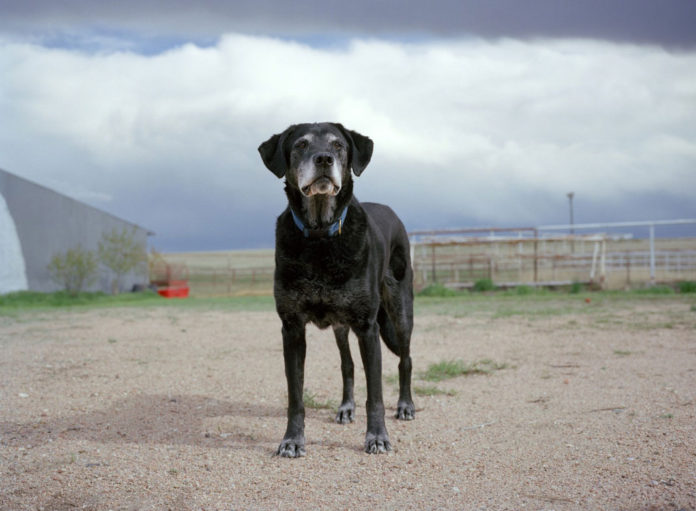
In 2011, Charlotte Dumas published a book of portraits entitled, “Retrieved,” portraits of the 12 dogs still alive, a decade after their service.
In my memory, the photographs of these dogs that appeared in the newspapers stayed with me most strongly: a dog being transported in a stokes basket on cables suspended high over the wreckage; another dog intently searching while maneuvering over enormous bend beams; dogs receiving eye drops after and in between shifts.