
“Hey, how was your weekend?” the person asks you. You respond that it was fine. Then the person launches into a sermon about all the cool things they did. “Mine was amazing! So on Friday my son won his karate tournament, on Saturday I competed in an Iron Man, and then on Sunday I perfected my croissant-making skills.” What initially seemed like a genuine interest in you suddenly shifts course and becomes an opportunity for the other person to talk about themselves.
If this conversation sequence sounds familiar, you have encountered a boomerasker–someone who asks a question, lets the other person answer, and then answers the question themselves. Like a boomerang, the question returns quickly to its source. As the old saying goes, and boomerasking encapsulates, most people don’t listen to understand, they listen to reply.
They ask you a question and then follow with a show-off response as described above.
2. Ask-complaining
This type of boomerasker likes to out-vent you.
When they ask you a question such as, “How was your day?” and you respond with a simple “long.” They then follow up with “Tell me about it! You think your day was tough–my day was brutal. Between the kids, my clients, and my husband, there is no time for me.”
3. Ask-sharing
This type of boomerasker feigns interest in your opinion but has already made up their mind and has been waiting to share it with you.
When the person asks you a question such as “What should we eat for dinner tonight?” You respond, “How about pizza.” They respond with, “Let’s have tacos. I know the best place to order from.”
We have all been on the receiving end of a boomerask. Truth be told, it is likely that we have also been a boomerasker. In the study, more than 90 percent of respondents acknowledged that they had asked and been asked a boomerasker-type question. Full disclosure, I was out with friends the evening after the Blue Origin flight and asked the group, “So what did you all think of the space flight?” Yes, I was curious about everyone’s opinion but I also couldn’t wait to weigh in myself. Perhaps this is a subtype of boomerasking: ask-opining?
The problem with boomerasking is that it ruins the magic of a good conversation. Failing to follow up on your partner’s answer, and answering the question yourself makes the person feel like you don’t care about them—and probably didn’t care about them when you asked the question in the first place. It was just an excuse for you to hijack the conversation and talk about yourself.
While research shows that talking about oneself feels good (yes, this is one of the reasons why so many people love therapy), there is good evidence that if we care about strengthening our social bonds, asking sincere questions, genuinely listening to others’ responses, and following up on those responses with care and curiosity is the way to go. As the authors of the study conclude:
Communicators who ask sincere questions and listen to their partners’ answers can uncover deeper, more supportive conversations and relationships, but people should avoid turning the focus of a conversation back to themselves before showing interest in their partner’s answer.
The people who listen to us are the ones we move toward. When we feel heard, we expand. When we feel dismissed, we retreat. Good manners have a role to play here. As my mother always told me, “Whatever you do, don’t talk too much about yourself.” Put simply, focus on the other person. Show interest in them before proving how interesting you are to them.
“I feel so scattered,” explained Ava. Like many people I know, my patient Ava was having a hard time focusing. “I open my phone to check the weather but then a notification pops up about some infuriating political news so I check X, and then open Instagram, and then I get a message from my mom but before I reply, my friend sends me a link to a celebrity scandal, and I quickly check the status of my Amazon order. By the time I finally put my phone down and try to get back to work, I realize I never got around to checking the weather. My attention is all over the place.”
What Ava is describing is “popcorn brain,” a term coined by David Levy, a researcher at the University of Washington, to describe a shortened attention span and the experience of overstimulation. Like popping corn kernels in a pot, attention jumps from one thought to the next. Popcorn brain is characterized by diminished focus, heightened stress, fatigue, information overload, attentional deficit issues, increased anxiety, and an overall detrimental impact on relationships and quality of life. Sound familiar?
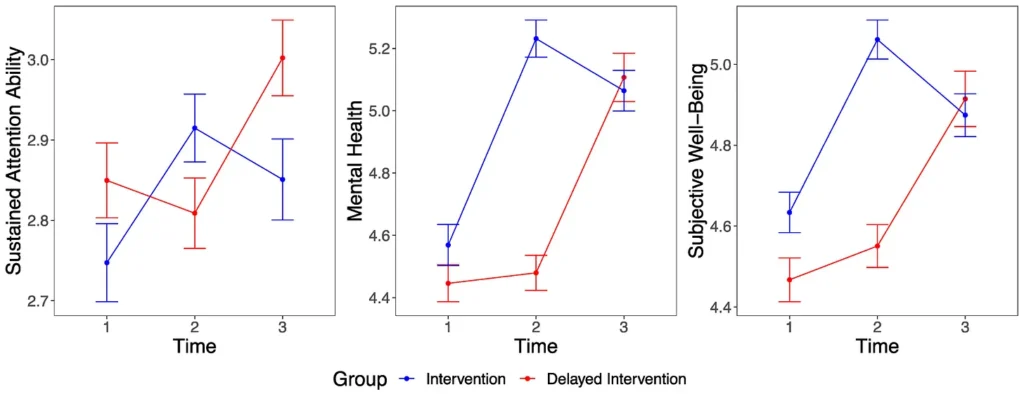
The cognitive disarray caused by popcorn brain is exhausting and makes it hard to get anything done. Thankfully a study published in PNAS Nexus offers a simple solution: spend less time online. Researchers found that people who blocked internet access on their cellphones for just two weeks reported significant improvements in mood and ability to focus. Ninety one percent of people who tried the two-week detox said they felt meaningfully better. The study only restricted internet access on their phones, so participants were still able to text and make calls. If they wanted to read the news, online shop or check social media, they could from an iPad or laptop. In other words, they were not totally cut off from the internet, it just wasn’t in the palm of their hand. Constant connection has its costs.
Attention, mental health, and SWB improve after 2 weeks of blocking mobile internet. In the Intervention group, participants blocked mobile internet access from T1 to T2. In the Delayed Intervention group, participants blocked mobile internet access from T2 to T3.
Even the people who did not fully adhere to the rules of the intervention experienced significant improvements in mental health, wellbeing, and focus. The analysis suggests that the benefits can be partially explained by the intervention’s impact on how participants spent their time. When they did not have access to mobile internet, they spent more time doing other things like talking to other people, exercising, and being in nature. Simply put, when endless scrolling wasn’t an option, participants looked up from their phones and engaged in other-oriented and outer-oriented activities.
The researchers summed the benefits of this simple intervention:
Blocking mobile internet for 2 weeks reduces smartphone use and improves subjective well-being including life satisfaction and positive affect, mental health more than antidepressants, and sustained attention as much as being 10 years younger. Despite the many benefits mobile internet offers, reducing the constant connection to the digital world can have large positive effects.
I have told everyone I know about this life enhancing study. While impressed with the results, nobody has said, “I cannot wait to try it. I’m starting tomorrow!” What gets between knowing what will make us feel better and actually doing what will make us feel better? Motivation, habit, and instant gratification are certainly factors. In my experience, collective action is one of the biggest impediments to behavior change. If nobody else is doing it, it’s hard to be the lone ranger. So instead of going it alone, loop in your friends and family. Try a week of everyone turning off access to mobile internet and see how you feel in seven days.
We all know that eating well, getting enough sleep, and exercise is good for our health. A Cambridge University study published in the British Journal of Psychiatry highlights an arguably more fun way to give ourselves a boost: going out on the town. While I am not suggesting you become a club rat, there is evidence that a night out may be just what the doctor ordered.
Researchers examined data collected from 2000 British adults over age 50 over a 10 year period. After analyzing data on their health and lifestyle, a clear pattern emerged. When people go out to enjoy a movie, show, or museum on a regular basis, their chance of becoming depressed plummets. Just one outing every few months was enough to cut their risk of depression by 32 percent. Those who went out once a month or more cut their risk of depression by nearly half. Given how down people are these days, that’s saying something. While it is unclear what exactly it is about cultural engagement that protects against depression, it is likely a combination of factors including social interaction, mental creativity, cognitive stimulation, and the gentle physical activity of just getting there.
I recently attended a concert in NYC and truth be told, it was terrible. It was a band I had loved from the 90s but 30 years later they were a little tragic. That said, there was something fun about the experience. I looked forward to going beforehand, I loved being with my friends at the event, and we laughed later about how awful it was. The social component looms large. I cannot help but think that social connection is what makes cultural engagement so protective against depression.
Dr. Gregg Henriques of James Madison University has argued that depression is a state of behavioral shutdown. When a person is feeling low, their knee jerk response is often avoidance and withdrawal. This unlocks a downward spiral of critical thoughts and an inner battle leaving the person even more stressed, isolated, and depleted. The only way to counteract Shutdown Syndrome, Henriques argues, is to harness what he calls the “paradox of effort.” Put simply, override the impulse to avoid and withdraw and instead deliberately participate in activities that move you toward your values, that boost positive emotions, and that enhance connection.
Avoidance may feel like the most natural response in the world, especially when it’s 12 degrees outside and everything seems upside down but withdrawing will never pull you out of the cave. If anything, it will make it colder and darker. Think of cultural engagement as a way out of the cave and as an antidote to Shutdown Syndrome.
Override the temptation to retreat. Ignore the allure of another night at home in front of the television. Make plans with a friend to do something and stick to them. We are often told that what we feel shapes what we do. But it goes both ways. What we do also shapes how we feel. Choose activities that engage you and connect you to others.
A dose of awe
Last week I went to see Caspar David Friedrich: The Soul of Nature at the Metropolitan Museum. It took my breath away. His vision of landscape is at once meditative, mysterious, and full of wonder.
Here is his iconic painting Wanderer above the Sea of Fog. The title captures the mood of how pretty much everyone I know feels at this moment.
About this work, Friedrich wrote, “It reminds me how small I am, but also how miraculous this life is.”
“I don’t jump to conclusions. I leap to them,” explained my patient Ava. In many ways, Ava believed that being a pessimist served her well. She carried an umbrella on sunny days. She traveled with an extra phone in case hers was damaged or lost. She expected her favorite basketball team to always lose.
Anticipating a negative outcome protected her from disappointment or being caught off guard. Her pessimism was both personal and global. The universe didn’t have her back, nor did anyone else. “If you expect people to let you down, you won’t be upset when they do.” When things worked out, she was shocked. It was an exception to the rule. When things went badly, she felt a sense of relief. She admitted she relished “I told you so” moments. There was something satisfying about being right about everything going wrong.
But Ava’s pessimism also locked her into a doom loop of worst case scenarios that was impacting her work and private life. She recognized that catastrophizing was preventing her from coping more productively in everyday life but said she was allergic to all the “think positive” messaging. “Looking at the bright side hurts my eyes,” she declared.
I explained that the idea is not to replace negative thoughts with positive ones, but to be more realistic. The goal is accuracy, not toxic positivity. As Scott Peck once observed, “Mental Health is dedication to reality at all costs.”
Given that it feels like the world is slowly devolving into one big dumpster fire, being a pessimist might seem like the only option. War, the environment, and the imminent takeover of our lives by AI are among the many reasons to have a doomsday disposition but new research published in Frontiers in Psychology suggests a more effective way to respond when everything feels upside down.
Dr. Xiangyou “Sharon” Shen of Oregon State University and her colleagues studied the experience of over 500 adults during the COVID pandemic and found that those who were clear-eyed about the challenges they faced but who also deliberately generated positive experiences coped more actively and creatively. Those who focused on positive future possibilities while remaining realistic about current circumstances found creative substitutes for what was lost, viewed obstacles as opportunities for growth, and maintained a sense of control over their situation. Dr. Xiangyou calls this “lemonading.” Lemonading doesn’t mean you don’t take your situation seriously, but it can mean you cope with it better.
Here are three taglines you can use to build real time resilience and to help you get better at turning lemons into lemonade.
Whenever you have a counterproductive or pessimistic thought:
Consider an alternative explanation
The phrase A more accurate way of seeing this is… will help keep things in perspective.
For instance, if you’re thinking “I am so nervous. This presentation is going to be a total disaster” you can respond with, “A more accurate way of seeing this is I’ll probably sound a little nervous at the beginning but then I’ll relax and it will all be fine.”
Gather evidencethat challenges an overly negative interpretation of a situation
Using the phrase That’s not true because… will help combat negativity bias and the default tendency to assume the worst.
If your thought is “my kids are so ungrateful” you can respond with “That’s not true because my son told me yesterday how much I helped him study for his test.”
Consider implications
The phrase A more likely outcome is… and I can… to deal with it will help you keep things real and also remind you that you have agency.
So if your negative thought is “I’m going to get fired and will never find another job I like” replace it with “A more likely outcome is my boss will be annoyed I didn’t get the job done on time and I can apologize and ask for help with projects I’m juggling.”
Bottom Line
Direct your spotlight toward possibilities for positive change and growth, illuminating a potential path forward even during dark times. Groundless pessimism will lock you into a doom loop of despair whereas evidence based optimism will ground you in reality.
Before January 1, please take a moment to ask yourself a few questions:
What challenged me most this year?
What did I learn from these challenges?
What surprised me?
What am I proud of?
Please stick to “What” questions because they invite curiosity and encourage openmindedness. Stay away from “Why” questions because they tend to promote criticism, regret, and rumination.
Remember, self-reflection is about learning not living in the past.
This is not a moment to beat yourself up or fixate on what could have and should have been. The point is to learn from the past so you can be more intentional about your future.
If pondering “What” questions is not your thing, please take a moment to read this classic poem by Linda Ellis. It’s a powerful reminder that how we spend our time matters.
The Dash
I read of a man who stood to speak at the funeral of a friend.
He referred to the dates on the tombstone from the beginning to the end.
He noted first came the date of the birth and spoke the following date with tears.
But he said what mattered most of all was the dash between the years.
For that dash represents all the time that they spent life on Earth.
And now only those who loved them know what that little line is worth.
For it matters not how much we own, the cars, the house, the cash.
What matters is how we live and love, and how we spend our dash.
So, think about this long and hard. Are there things you’d like to change?
For you never know how much time is left that can still be rearranged.
If we could just slow down enough to consider what’s true and real,
and always try to understand the way other people feel.
Be less quick to anger and show appreciation more,
and love the people in our lives like we’ve never loved before.
If we treat each other with respect and more often wear a smile,
remembering that this special dash might only last a little while.
So, when your eulogy is being read with your life’s actions to rehash,
would you be proud of the things they say about how you spent your dash?
—Linda Ellis
Reading this poem made me think about an essay entitled What is a Good Life? by legal and political philosopher Ronald Dworkin that was published in the New York Review of Books in 2011. He argued that our lives should not be valued by noteworthy outcomes, achievements, and accomplishments—in other words by our greatness. What really gives meaning to life is our goodness—the experiences, strivings, connections and stories.
He explained that assessing the success of this artistic endeavor should not focus solely on the outcome, the work of art in itself, or our achievements in life, but more importantly on the process that has led up to that outcome. In sum, life should be not valued on the outcomes, achievements or accomplishments. What really gives meaning to life is the personal experience and the inner stories.
He writes “The final value of our lives is adverbial, not adjectival—a matter of how we actually lived, not of a label applied to the final result.”
In other words, what matters is how we spend our dash.
I have a pet peeve. (Actually I have many pet peeves but will focus on just one for brevity’s sake.) It has become increasingly common to shorten the phrase “I love you” to “Love you.” Both in verbal and written communication, “love you” has hijacked the more labor intensive “I love you.” I suppose two syllables require less effort than three. Perhaps “Love you” is a little less cringy for a 13-year-old boy to hear his mom shout from the car when she drops him off at soccer practice than “I love you.”
According to the rules of basic grammar everyone learns in middle school, in the sentence “I love you” the “I” is the subjective pronoun, meaning it is the one doing the loving and the “you” is the objective pronoun, indicating the person who is loved. Dropping the “I” dilutes the verb. It says I care but not enough to take ownership of the action.
Eliminating the “I” makes it a little less personal but isn’t that the point of saying I love you? I cannot help but think that when we remove the “I” that we are also distancing ourselves from the sentiment. “Love you” is more casual but also less serious and heartfelt. It rolls off the tongue but I would argue that it also falls flat. Surely, hearing “I love you” from your partner or your friend means a lot more than the expedient “love you.” In my humble opinion, if you are going to say it, mean it.
According to the researchers: “Texting abbreviations negatively affect interpersonal communication by decreasing perceived effort, which in turn leads to lower perceived sincerity and responsiveness.”
Writing “thx” instead of “thanks” leaves the impression that the sender cannot be bothered to communicate in a substantive way. Is writing those two extra letters really that time consuming and exhausting? The subtext of a heavily coded message is clear: I am too busy or too important to concern myself with such trivial matters. As the study highlights, if you want someone to show that you care and to receive a response, make the effort to write “Happy Birthday” instead of HBD.
LOL
In addition to communicating low effort, abbreviations can also lead to confusion. I heard a story about someone who used LOL assuming it meant “lots of love.” It was only after he sent a condolence text to a friend whose father had died and signed off with LOL that he learned it meant “laughing out loud.” Note to self: when in doubt, spell it out.
Not to be a hypocrite but I cannot help but think that the abbreviations below get a pass…