
How We Talk About Mental Health Matters

The practice of seeking support when we’re distressed is typically associated with emotional well-being. It makes sense: Most of us believe that having somebody—a friend, a parents, a therapist—who listens to all our travails will make us feel better.

But that may not be the case. In fact, endless discussions about our problems can inadvertently amplify distress.

A patient of mine who had a difficult relationship with her mother-in-law would spend hours rehashing the latest incident or insult with her best friend and speculating about what her “monster-in-law” might do next. Venting was her go-to conversation. Afterward, however, she would often feel even angrier and more agitated.

The reason is that individuals who ruminate, or dwell on negative feelings and distress, have a hard time letting go of what’s bothering them, which leads to a cycle of negative thinking. The more a person ruminates, the worse they feel, which then contributes to more rumination.

Co-rumination—when we ruminate with someone else—isn’t any better, even if it feels good in the moment. But excessively discussing personal problems without ever coming up with a solution can make you feel worse, sending you into an emotional sinkhole. A 2022 study found that co-ruminating about Covid-19 with friends and on social media was associated with heightened depression and anxiety symptoms.

The same is true for parents who, naturally, want to hear of all the difficult things their child is enduring. But there is evidence that turning any problem into a continuing centerpiece of conversation can ultimately undermine the development of coping skills. If your teenager is upset about something, asking her to recount every little detail to you and perhaps later to your partner—“Tell your dad exactly what happened today at school”—could make her feel even worse. You might be sending the unintentional message that the issue is more serious than it is, or that you believe your child can’t handle the situation.

An alternative approach

So, what should people do instead when dealing with a distressed friend or relative?

I may be a “feelings doctor,” but I worry about encouraging internal fixation and problem talk. A basic principle of every nonpharmaceutical treatment for depression and anxiety involves putting some distance between oneself and one’s emotions and acknowledging that feelings aren’t facts.

Psychodynamic therapy, mindfulness meditation and exercise, to name a few treatments, all create space between us and what is running through our head. Deep breathing, pretending to be a fly on a wall, imagining your thoughts are leaves on a stream floating, are well-recognized tools that dilute the power of feelings, provide some perspective, and promote self-regulation.

Cognitive behavioral therapy, one of the most widely studied interventions, teaches patients to identify and challenge faulty habitual thinking patterns known as cognitive distortions such as all-or-nothing thinking and emotional reasoning. Rather than rehashing problems, such therapy entails learning that thoughts aren’t always a reflection of reality and encourages reframing negative thoughts.

Focus on strengths

So if your child had an issue with Johnny today, don’t let the first question you ask after school tomorrow be, “Was Johnny mean to you again today?” If you don’t let it go, your child won’t either. When listening to loved ones, stay calm, express empathy, and encourage them to consider the situation from alternate perspectives. These are far more effective methods for working out problems, rather than to mine for pain and dwell on resentment.

Instead of only asking about what’s wrong, consider inquiring about what’s strong.
Focusing on a person’s strengths may be a more effective strategy for navigating challenges than fixating on the problems.

Similarly, if your best friend calls you to talk about something that is bothering her, avoid questions that encourage her to revisit every detail. “Start from the beginning. Tell me everything!” will only lead to a play-by-play of what took place and what she was feeling. Consider instead posing a question that might help your friend gain some distance from the situation. I often ask my patients, “If someone else were in this situation, what advice would you give them?” Rather than dwelling on the details of what happened, help the person to generate a plan of action and to capitalize on their strengths.

To paraphrase Nobel Prize-winning psychologist Daniel Kahneman, nothing in life is quite as important as you think it is while you’re thinking—or talking—about it. I don’t mean to imply that we shouldn’t talk to loved ones about what’s bothering us. All I am saying is that it shouldn’t be the only thing we talk about.

I wish you all the best,

Dr. Samantha Boardman

How to Stop Jumping to Conclusions

What makes you tick?

This is the question that drew me to psychiatry in the first place. What interested me most was not what people did but why they did it. What I have learned along the way is that there is so much that we get wrong about others. All too often, in an attempt to make sense of someone else’s behavior, we jump to conclusions about their “true self.” Using a few breadcrumbs of information, we are quick to make assumptions and attribute their behavior to a fixed aspect of their personality. The person who cut me off in traffic is surely a jerk. The woman who screams at her child lacks patience. The teenager who breaks the vase is clumsy. The dog owner who doesn’t pick up her dog’s poop is selfish. The coworker who leaves early is lazy.

Put simply, we see other people’s behavior as a reflection of who they really are. This is known as “correspondence bias”— we assume that their actions correspond to their personality. In doing so, we disregard all the other reasons that might explain their actions. In the process, we underestimate their intentions and the situation. We ignore external factors and contributing circumstances.

But, when it comes to ourselves, we do the complete opposite—we attribute our behavior to the situation and discount the role of personality. If I cut someone off in traffic, it’s because I am late for an important meeting. If I scream at my daughter, it is because I didn’t sleep well last night and she said something inappropriate. If I break a vase, it’s an accident. If I don’t pick up after my dog, it’s because I ran out of poop bags. If I leave work early, it’s because I have a doctor’s appointment. The only reason my behavior is anything less than stellar is because of external reasons.

We are quick to make excuses for ourselves but tend not to extend the same generosity to others.

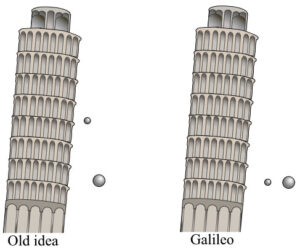
Psychologist Kurt Lewin likened this tendency to think that others are as they act to Aristotle’s understanding of the physical world. Aristotle believed that objects behaved according to their inherent properties. Rocks fell to the ground to get closer to the earth and flames rose to the sky to reach heaven. Accordingly, Aristotelian physics held that the heaver an object, the faster it would fall. It wasn’t until Galileo came along centuries later that the role of external forces was considered. His insight that the behavior of objects must be understood in the context of the situation transformed physics. It is said that he demonstrated the role of air resistance by dropping objects from the top of the Leaning Tower of Pisa.

When it comes to judging the behavior of others, we are stuck in an Aristotelian mode—ready to make assumptions about their true nature based on a few observations and limited information. But in explaining our own behavior, we are Galileans—full of understanding and awareness of external factors.

Thanks to correspondence bias, we jump to conclusions and are left with the false impression that we really know someone, that we’ve got their number, for better or for worse. As Harvard psychologist Daniel Gilbert points out in a famous paper on the topic:

We may strive to see others as they really are, but all too often the charlatan wins our praise and the altruist our scorn. Juries misjudge defendants, voters misjudge candidates, lovers misjudge each other, and, as a consequence, the innocent are executed, the incompetent are elected, and the ignoble are embraced.

Correspondence bias is famously hard to overcome.

Even when we’re fully aware of the outside pressures that people face, we still understand their behavior as a reflection of enduring qualities. In a well known experiment, subjects were shown essays that opposed or supported Cuba’s president, Fidel Castro. Even when the subjects were told that the essayists had been instructed by a debate coach to defend a particular point of view, many of the subjects still inferred pro-Castro leanings in the essayists that defended him. As Gilbert observes, the subjects were basically saying:

“Well, yes, I know he was merely completing the assignment given him by his debate coach, but to some degree I think he personally agrees what he wrote.”

Correspondence bias is problematic because it distorts judgments and leads to misunderstandings. I worry that the rise of everyday use “therapyspeak”—prescriptive language describing certain psychological concepts—amplifies correspondence bias. Based on a tidbit of information or unpleasant interaction, we can justify writing someone off as “toxic” or “demanding.” Connections and potential connections suffer as a result.

Jumping to conclusions about what makes someone tick gets us nowhere. What we can do is simple: give everyone you meet the benefit of the doubt. Consider their intent. Resist wound collecting. Think about what else might be going on in their lives. Last but not least, ask yourself, “What would Galileo say?”

I wish you all the best,

Dr. Samantha Boardman
Why Learning From Failure Is the Key to Success

Without any experience in retail and very little cash, Sara Blakely founded Spanx when she was 29 years old. How did she do it? Was it her parents’ kind words and doting support? Not exactly. As highlighted in an article Blakely’s parents were not into coddling:

Some parents are content asking their children, “Did you have a good day?” or “What did you learn at school?” Not the Blakely household. The question Sara and her brother had to answer night after night was this: “What did you fail at today?” When there was no failure to report, Blakely’s father would express disappointment.

An “if you’re not failing, you’re not growing” approach may seem harsh by today’s standards. It’s essentially the opposite of how parents and educators think about learning:

From an early age, children are taught that success means having the right answers, and that struggling is a bad sign, the sort of thing you do when you’re not quite “getting it” or the work is too hard. Throughout much of their education, students are encouraged to finish assignments quickly. Those who don’t are sent off to tutors. After 12 years of indoctrination, it’s no wonder that so many of us view failure the way we do: as something to avoid at all cost. In reality, it’s only by stretching ourselves that we develop new skills.

As Blakely reminds us, frustration is part of the learning process. Failure, (dare I say the unsayable “f-word”?”) is something to be learned from rather than avoided. Without struggle and failure, we end up with “perfect” children who are terrified of making mistakes. They are fragile teacups—ideal for display but easily broken.

I recently heard about about a new and rather unusual form of therapy designed to help conquer fear of rejection and failure called Rejection Therapy. The idea is to make a game out of rejection by creating situations where you get rejected each day.

Here are a few examples:

  • Request a lower interest rate from a credit card provider
  • Sit beside a stranger and strike up a conversation
  • Ask for a discount before purchasing something

You get the picture. By forcing yourself to do the thing you fear, you de-fang it. The focus is on process not outcome.

Rejection Therapy may have a place at the dinner table. In addition to asking your kids what went well in the day, consider channeling the Blakelys. If the question, “What did you fail at?” seems a little harsh, consider asking “What was hard or challenging for you today?”

It may save years of (Rejection) Therapy in the future.

I wish you all the best,

Dr. Samantha Boardman

An Antidote for the End-of-Summer Blues

Too soon?

It may only be August but pumpkin spice season is officially upon us. Brands are already rolling out their fall-inspired offerings and Christmas merch is popping up too. Apparently this is known as “Christmas Creep.” Long before a leaf hits the ground, retailers are telling us the summer is over. Thanks but no thanks.

Autumn anxiety may not be an official diagnosis but the annual experience of increased stress at this time of year is very real.

As seasons go, fall is cited by many of my patients as the most stressful. The end of summer, a new school year, a more rigid schedule, and the impending holidays (likely amplified by Christmas Creep) all contribute to the end-of-summer blues.

My son once described August as the Sunday of the summer. The thought of homework, going to bed early, and having to wear shoes again made him shudder. When a back-to-school commercial played on the television, he would leave the room. The countdown was painful. The closer Labor Day loomed, the harder it became to think about anything else. One late August evening, feeling a chill in the air, he said, “I almost wish school started tomorrow. I just want to get it over with.”

What my son was experiencing was dread. Dread is it’s own unique form of misery. Defined as an “extreme reluctance to meet or face,” dread conjures impending doom. Unlike anxiety which is characterized by uncertainty and generalized worry, dread is more specific. The cruelty of dread is its inevitability. Anxiety is imagining there might be a hungry monster under the bed. Dread is knowing there is a hungry monster under the bed who is about to come out.

Here’s why dread can be so devitalizing

Anticipating something horrible can be horrible in itself. Or as Tor Wagner of Columbia University observed, “expecting an emotional event is an emotional event.” A 2014 study underscores the discomfort of dread. When given the choice of receiving an immediate strong electrical shock versus a milder one in the future, most participants opted to receive the more intense shock right away. Anticipating unpleasantness was so unpleasant that they would rather receive more voltage than have to endure the torment of waiting for it.

Dread is a catalyst for catastrophizing. Instead of imagining the most realistic outcome, dread distorts our thinking so that the worst case scenario becomes the only possible scenario. In addition to warping our perception of the future, when we’re awash in dread, the present becomes purgatory, a prelude to the dreaded event. It’s hard to enjoy anything in the moment when we’re preoccupied with the thoughts of imminent misery.

Thankfully, there are some research-based strategies to make dread a little less devitalizing:

1. Define it

To prevent dread from hovering like an amorphous ever-expanding cloud, casting dark shadows over every aspect of your life, find the exact words to describe how you’re feeling. Be as precise as you can. Whip out a thesaurus if necessary. The more precisely you can define how you’re feeling, the easier it will be to manage your uncomfortable emotions.

2. Distract yourself

Sitting around waiting for the dreaded event can be as painful as the dreaded event itself. To combat the paralyzing effects of dread, actively draw your attention from whatever you’re dreading. Physical activity, breathing exercises, and spending time outdoors are excellent antidotes for dread.

3. Distance yourself

To break the cycle of overthinking—or rumination—about the dreaded event, imagine the worry-provoking event from a distance. Visualizing it from afar facilitates better coping strategies and reduces emotional reactivity.

Dread is powerful but need not be all powerful. Use the 3 Ds to defend against it and perhaps even lean into it.

As Pulitzer Prize winning novelist Barbara Kingsolver observed:

“The changes we dread most may contain our salvation”

I wish you all the best,

Dr. Samantha Boardman

Are We Afraid of the Wrong Things?

After all these years, the movie Jaws still haunts me. I love to swim in the ocean but lurking in the back of my mind is the possibility of a man-eating monster lurking just below the surface. Apparently, I am not the only one. According to a survey, 43 percent of people who have seen Jaws have lingering fears of the ocean.

Consider the following:

  • You have a 1 in 63 chance of dying from the flu and a 1 in 3,700,000 chance of being killed by a shark.
  • Over 17,000 people die from falls each year. That’s a 1 in 218 chance over your lifetime, compared to 1 in 3,700,000 of being killed by a shark.
  • In 1996, toilets injured 43,000 Americans. Yes, it is more likely I will come face to face with a hostile toilet bowl than with an angry shark.

Sharks inspire terror but the mosquito should make our knees quiver. No other species, including our own, is responsible for the loss of as many human lives each year as mosquitos that kill 725,000 people annually. Humans murder around 475,000 other people each year. Snakes kill around 50,000 while dogs (mainly from rabies) claim another 25,000 lives. Some of the most feared animal (sharks, wolves) kill fewer than 10.

When it comes to fear, logic and reason fly out the window. Barry Schwartz explains:

People have great difficulty understanding risks. The weight a person gives to a scenario—flood, fire, winning the lottery—should depend on its likelihood. In fact, it depends on how easily it can be envisaged. People will pay more for air-travel insurance against “terrorist acts” than against death from “all possible causes.”

That said, fear serves an important function.

It alerts us to danger and enables us to act quickly. Think of swerving out of the way of an oncoming truck—you turn the steering wheel before you even register you are afraid. It is instinctive.

We see this all the time in the animal kingdom. When a gazelle is chased by a lion, her body goes into survival mode—stress hormones flood the bloodstream, the heart goes into overdrive, extra blood is shunted to muscles to facilitate running, awareness intensifies and vision sharpens as the body devotes all its energy to escaping the beast. If the gazelle outruns the lion and survives, she returns to the watering hole with her fellow gazelles and resumes her routine hanging out and eating grass. Stress hormones return to normal, along with blood pressure and heart rate. She doesn’t dwell on how upsetting it was to be chased by a lion, nor does the fear of another attack consume her.

People are not like gazelles. Problems arise when we are in fight or flight mode all the time. It isn’t quite as easy for us to flip back into relaxation mode. Those with chronic stress and anxiety experience the equivalent of the lion chase throughout the day, placing them at risk for a number of mental and physical problems.

My advice:

  • Ask yourself: what are the odds of this terrible thing really happening?
  • Know what you can control and what you cannot.
  • Personalize a strategy to calm your mind. Meditation, exercise, listening to music, spending time outdoors, reading a book, visiting a museum, spending time with friends, volunteering, and cooking are all examples of ways to quiet an unquiet mind.

Find the one that works for you to channel your inner gazelle.

Bottom Line: Remember, FEAR has two meanings. Forget Everything And Run or Face Everything And Rise. The choice is yours.

I wish you all the best,

Dr. Samantha Boardman

Get a Hobby. Seriously…

How do you spend your free time?

Before you say, “Free time? I don’t have any free time” consider the following. According to the most recent American Time Use Survey even busy people have more free time than they might think—close to four hours during weekdays and more than five hours during weekend days. The biggest chunk of free time is spent in front of a television or a screen. Screens trump socializing, exercising, and pretty much everything else.

The reality is we flitter away hours a day engaged in mind-numbing activities. This creates a perception gap—the feeling that we have no time even though we have quite a bit.

How much free time do we really need?

Authors of a research paper entitled “The Effects of Being Time Poor and Time Rich on Life Satisfaction” found that 2.5 hours per day (for people who work) is ideal. Less than that and we feel stressed. More than that and we feel like bumps on a log—lazy and unproductive. “Though so many people in modern society yearn for more free time in their days to do what they want, they really only need a few hours to enjoy optimal satisfaction in life,” explained the authors. The reality is that most of us already have enough free time. The problem is how we use it.

Time well spent

Why do we gravitate toward devitalizing pastimes like watching TV, surfing the internet, and checking social media, even though most of us recognize that these activities give us a fleeting boost at best? A study, “The Paradox of Happiness,” published in the Journal of Positive Psychology explores this curious behavior. “Because work is often highly demanding, people feel their free time is too precious to risk losing to yet more challenging activities, so they resign themselves to experiencing happiness through easy ‘relaxing’ entertainment,” explain the researchers. These activities even have a name. They are called “demand shielding” because they require little of us physically, intellectually, and socially.

But the relief provided by less-challenging activities is temporary. The moment we return to reality, the stress comes rushing back. It is more beneficial to adopt a more intentional approach which includes activities that provide the sense you are living your life in a full and satisfying way. Effortful activities that stretch the body or the mind may not be experienced as pleasurable in the moment, but when we recall them, we’re more likely to think, Wow, that was awesome! Or That was time well spent.

An antidote for feeling “crazy busy”

If passive leisure is not the answer, what is? A recent poll by the American Psychiatric Association found that engaging in creative activities is a reliable revitalizer. The report found that Americans who rate their mental health as very good or excellent tend to engage in creative activities more frequently than those who rate their mental health as fair or poor.

“Creative activities aren’t just for fun, they can help us take a step back from the daily grind, use our brains differently, and relax. Picking up that paintbrush or solving a tricky puzzle can truly move us to a different mindset,” explained APA President Petros Levounis, M.D.

When asked which creative activities they used to relieve stress and anxiety, adults reported a variety of interests:

  • Listening to music: 77%
  • Solving puzzles: 39%
  • Singing or dancing: 25%
  • Drawing, painting or sculpting: 24%
  • Crafting: 19%
  • Creative writing: 16%

Additionally, 15% attend concerts, 14% create online content for fun, 13% play a musical instrument, 9% visit an art museum, and 11% reported other activities such as gardening or cooking.

I have taken these findings to heart. The creative activities that suit me best are blasting Taylor Swift, doing Wordle and jigsaw puzzles, and going to museums. I recently saw the Lauren Halsey show on the roof of the Met and can say, unequivocally, that it was a mood-booster.

Whatever creative activity you choose, go all in. To get the most out of the experience, resist the urge to check your phone. Whenever we disengage, we turn blocks of time into fragmented time and dealing with streams of time confetti aggravates the sense of being time poor.

Bottom Line: The experience of being “time poor” or “time affluent” is influenced by the choices we make. As Beverly Adamo said, “It’s not about time, it’s about choices. How are you spending your choices?”

I wish you all the best,

Dr. Samantha Boardman