
We live in a world that tells us the goal is to be larger than life. But what if we’re missing out on the invaluable experience of feeling small?
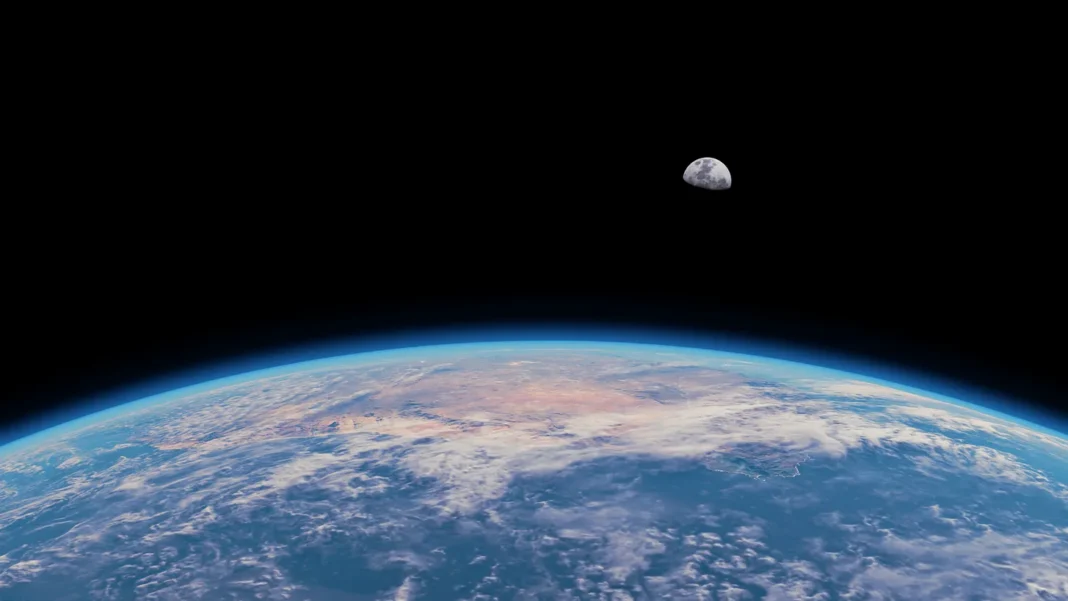
Four astronauts launched Wednesday evening from Kennedy Space Center, bound for the Moon. It is the first crewed mission beyond Earth’s orbit since 1972. In a few days, Reid Wiseman, Victor Glover, Christina Koch, and Jeremy Hansen will look back and see our planet the way almost no one ever has.
If history is any guide, it will change them.
The experience even has a name. The “Overview Effect” refers to the profound shift astronauts report when viewing Earth from outside its atmosphere, an overwhelming emotion and a sudden, visceral sense of identification with all of humanity. Astronaut Rusty Schweickart described it this way in his essay No Frames, No Boundaries, “You look down and see the surface of that globe you’ve lived on all this time, and you know all those people down there and they are like you, they are you and somehow you represent them.”
At the heart of this experience is awe, that remarkable feeling that briefly lifts us out of ourselves. Two things tend to happen when we encounter it: we feel diminished in the presence of something greater than ourselves, and we feel moved to be better to others. The Awe Experience Scale, developed by David Yaden, Dacher Keltner, and colleagues, captures it in plain language: I felt my sense of self shrink. I felt closely connected to humanity. I felt I was in the presence of something grand. I experienced something greater than myself. The self doesn’t disappear in these moments. It expands.
Research backs this up. Awe has been found to expand our sense of time, reduce self-focus, increase generosity, and enhance well-being. It makes us more creative, more connected, more capable of collaboration. A Stanford study found that awe made people less impatient and more willing to help others. A UC Berkeley study found that awe produces what researchers call the “small self” and that this smallness, far from being deflating, increases generosity and ethical behavior.
Awe has been part of human thought for a long time. Burke and Kant wrote about the sublime, experiences that exceed ordinary beauty and stop us cold. Darwin recognized wonder as a fundamental human emotion. William James brought these experiences into psychology in 1902, and Maslow later argued that the capacity for awe wasn’t mystical or rare but essential to a good life. The modern scientific study of it largely begins with a 2003 paper by Keltner and Haidt, who defined awe as what happens when we encounter something so vast we have to stretch our minds to take it in.
The Paradox of Smallness
We live in a culture relentlessly invested in bigness. Build your brand. Maximize your platform. Optimize your presence. Be seen. The pressure to perform, to grow, to flex on social media, at work, and in the quiet social competition of daily life is exhausting and unrelenting.
The Overview Effect offers a different kind of wisdom. It is a reminder that what actually produces meaning, connection, and well-being is not magnitude but perspective. As astronaut Ed Gibson put it: “You see how diminutive your life and concerns are compared to other things in the universe. Your life and concerns are important to you, of course. But you can see that a lot of the things you worry about do not make much difference in an overall sense. The result is that you enjoy the life that is before you… it allows you to have inner peace.”
Put simply, the small self may help us be our best self.
Find Your Own Overview Effect
Few of us will ever leave the atmosphere, but the feeling those astronauts are describing is closer than we think. Here are five simple ways to start:
Take an awe walk
Dacher Keltner’s research found that just 15 minutes of walking with intentional curiosity, really looking and noticing what is larger than you, significantly improved emotional well-being. The instruction is simple: widen your gaze, look outward rather than inward, and notice what is larger than you.
Look up
Literally. A clear night sky remains one of the most reliable awe inducers available to anyone, anywhere. There are an estimated two trillion galaxies in the observable universe. The light reaching your eyes from some of those stars left its source before humans existed.
Seek beauty
Astronauts’ accounts of the Overview Effect are full of descriptions of beauty including the colors of the ocean, the impossible blue of the atmosphere, the curve of the Earth at the horizon. We tend to wait for beauty to find us. It works better the other way around.
Volunteer and serve
Astronauts consistently return from space with what Edgar Mitchell called “a compulsion to do something.” Directing attention away from yourself and toward another person’s need produces many of the same benefits as awe: reduced self-focus, a sense of connection, meaning that outlasts the moment.
Practice quiet
At its core, the Overview Effect happens when the noise stops. When there is nothing to perform, no metrics to hit, no audience to play to. A walk without a podcast, a moment of genuine stillness, a pause long enough to actually notice where you are.
Bottom Line
What those four astronauts are feeling is not reserved for those with the right stuff. It is available for anyone willing to pay attention.
I wish you all the best,
Dr. Samantha Boardman