
Is This Why You Overindulge?

We all have so much going on in our lives, so let me distill the research on wellbeing for you. Think of these quick bits as a personal apothecary that you can read, refer back to, and even send to a friend or loved one who might need a dose of practical, actionable strategies that are life-enhancing and resilience-building.

Here are this month’s positive prescriptions:


If you don’t want to be underwhelmed by pleasure, don’t overwhelm yourself with distractions.

According to new research published in the Journal of Personality and Social Psychology, distraction dilutes enjoyment, leading to overindulgence later on. Participants in the study entitled Underwhelming pleasures: Toward a self-regulatory account of hedonic compensation and overconsumption were asked how much they expected to enjoy their lunch before eating it. They were then asked to eat their lunch under one of three conditions: no distraction, moderate distraction (watching a video) and high distraction (playing Tetris). Afterwards, they reported on their actual enjoyment, satisfaction, and desire to eat more. They also reported on their snacking later in the day. Participants who ate while distracted enjoyed their lunch less and felt less satisfied, which was associated with greater snacking later on. The researchers termed this behavior “hedonic compensation” which they theorize applies to other activities beyond eating. For example, people who are distracted while watching a movie or playing a game may be more likely to engage in additional consumption (e.g., checking social media) to compensate for a diminished enjoyment of the original activity.


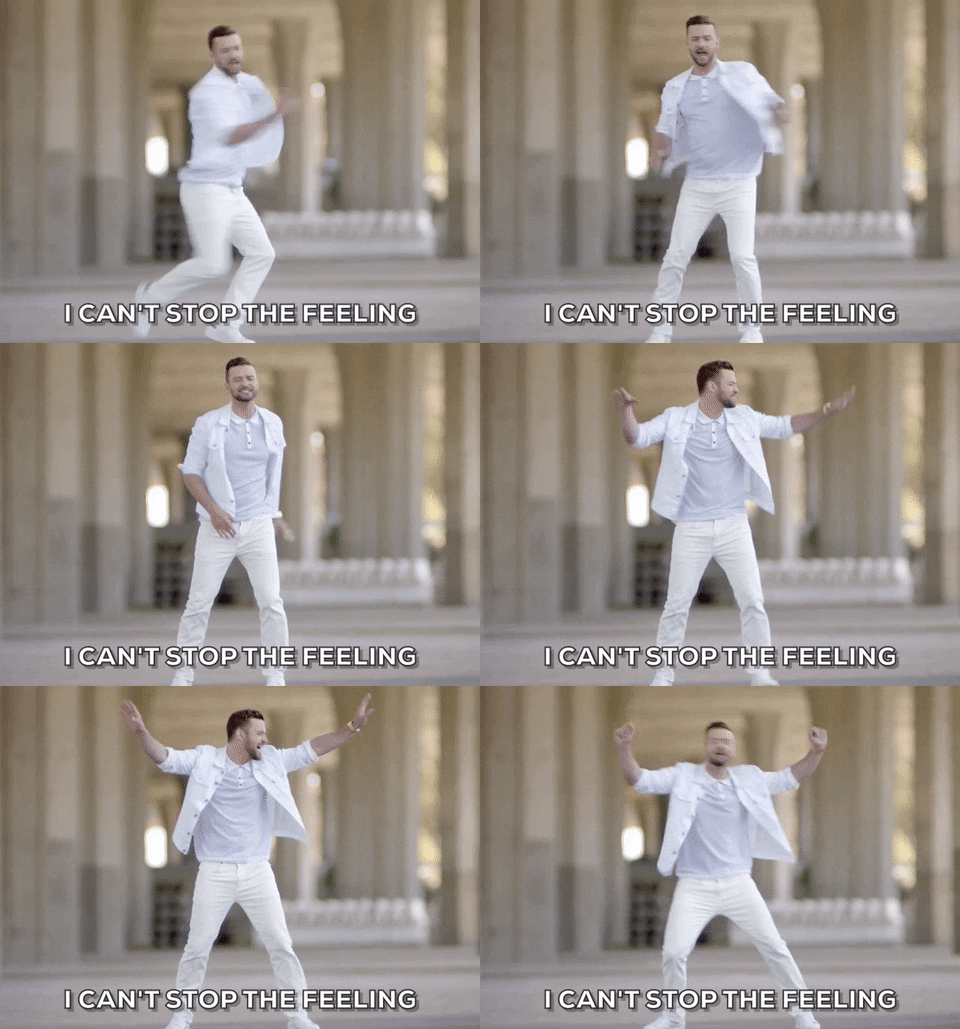
As the old saying goes, there are shortcuts to happiness and dancing is one of them.

Moods dictate how we move. When we’re happy, we tend to walk with a spring in our step and when we’re unhappy, our movements are more restricted. But does the reverse work too? Does how we move impact our mood? A study published in The British Journal of Psychology found that practicing a happy dance boosted participants’ mood and motivation. If you’ve hit a wall at work, it just might be time to get up and dance. Need inspiration? Follow Justin Neto on Instagram. Of course everyone in his class is smiling.


If you want to improve your mood, go outside and listen to birds. Yes, you read that correctly.

We often hear about skyrocketing stress levels in college students. A new study finds that birdwatching is a particularly effective tool to help them keep calm and carry on. Students who got into birding reported improved wellbeing and lower distress than those who did not. Five 30-minute bird-watching sessions was all it took. Related research has found that hearing birdsong can have a sustained positive impact on one’s mood. On those days when you just don’t feel like exercising, the simple act of going outside can give you a lift. Just be sure to leave your headphones at home. The podcast can wait.


Respecting our children’s autonomy improves the chances of them actually listening to us.

If you have a teenager and get a lot of eyerolls, this new study from UC Riverside might be of interest. When parents offer unsolicited advice (I know, I know … sometimes we just can’t help ourselves!) and it’s delivered in a way that promotes independence and respects their autonomy, our kids are more likely to take it to heart. So instead of saying “I don’t think you should play video games because you should study,” try “What’s your plan for this afternoon? You mentioned yesterday that you wanted to get a head start studying for your math test.” See the difference? If we want our children to take our advice, avoid finger wagging or “shoulding.”

I wish you all the best,

Dr. Samantha Boardman

Athlete or Not, Science Says to Do This if You Want to Keep Your Cool

A free throw in basketball is an intensely stressful situation. All eyes are on the player. Will they or won’t they sink the shot? Merely watching is anxiety-provoking for me. It’s hard to imagine what’s going through the head of the player in such a pressure-cooker moment.

In an article in Wired entitled Free Throws Should Be Easy. Why Do Basketball Players Miss? Robbie Gonzalez explores the mechanics and magic of making the shot. On paper, the free throw could not be more straightforward. It’s a direct, unguarded shot at a hoop 18 inches across, 10 feet off the ground, and 15 feet away. Like a carefully controlled experiment, the conditions are exactly the same every single time.

For 20 years, Larry Silverberg, a professor at North Carolina State University, has studied the physics of the free throw using computers to simulate trajectories of millions of shots to dissect the mechanics of the perfect throw. According to his findings, a successful free throw boils down to four parameters: the speed at which you release the ball, how straight you shoot it, the angle at which it leaves your hand, and the amount of backspin that you place on it.

Of course, practice is key but not any old practice. As anyone who has ever choked on a test knows, there is often a gap between preparation and actual performance. To avoid paralysis by analysis in a free throw situation, practicing under conditions that simulate high pressure scenarios can help. Cranking up the music, using an audio of a crowd booing, having the rest of the team run around the court 10 times if the free thrower misses, and competing against the clock can help build mental stamina.

Technique and practice are important. So are your teammates. A brand new study published in Psychology of Sport and Exercise suggests a less obvious tactic to improve the performance of a free thrower: a friendly tap on the back. Before you raise an eyebrow, plenty of research shows that non-verbal gestures of support are powerful stress-reducers so it makes sense that a small gesture conveying to the free thrower that “you got this” can boost confidence. Researchers from the University of Landau and Purdue University analyzed videos of basketball games and found that the chances of scoring rose when teammates showed their support through touch, such as a hand on the shoulder. Put simply, in one of the most stressful athletics tasks imaginable, physical touch enhanced performance.

There is a lesson here for those of us who don’t often find ourselves in the middle of a heated basketball game. Gestures of support matter in everyday life and they need not always be spoken. Showing that you care does not always require an in depth discussion. A pat on the back, a warm hug, and holding hands are powerful communicators of affection. People who experience higher “felt love” – brief experiences of love and connection in everyday life – also have significantly higher levels of psychological well-being, which includes feelings of purpose and optimism compared to those who had lower felt love scores.

Chances are they might also be better at sinking a free throw.

I wish you all the best,

Dr. Samantha Boardman

Reflect, Don’t React

According to the old adage, if you don’t have anything nice to say, don’t say it at all. (As an aside, growing up, my parents had a needlepoint pillow that occupied prime real estate on the living room sofa that read, “If you don’t have anything nice to say, come and sit right here by me” but that’s a story for another day.) The notion of keeping nasty comments to oneself seems almost antiquated given the venom constantly unleashed online and in real life. When it comes to outrage, “better out than in” is the prevailing mindset.

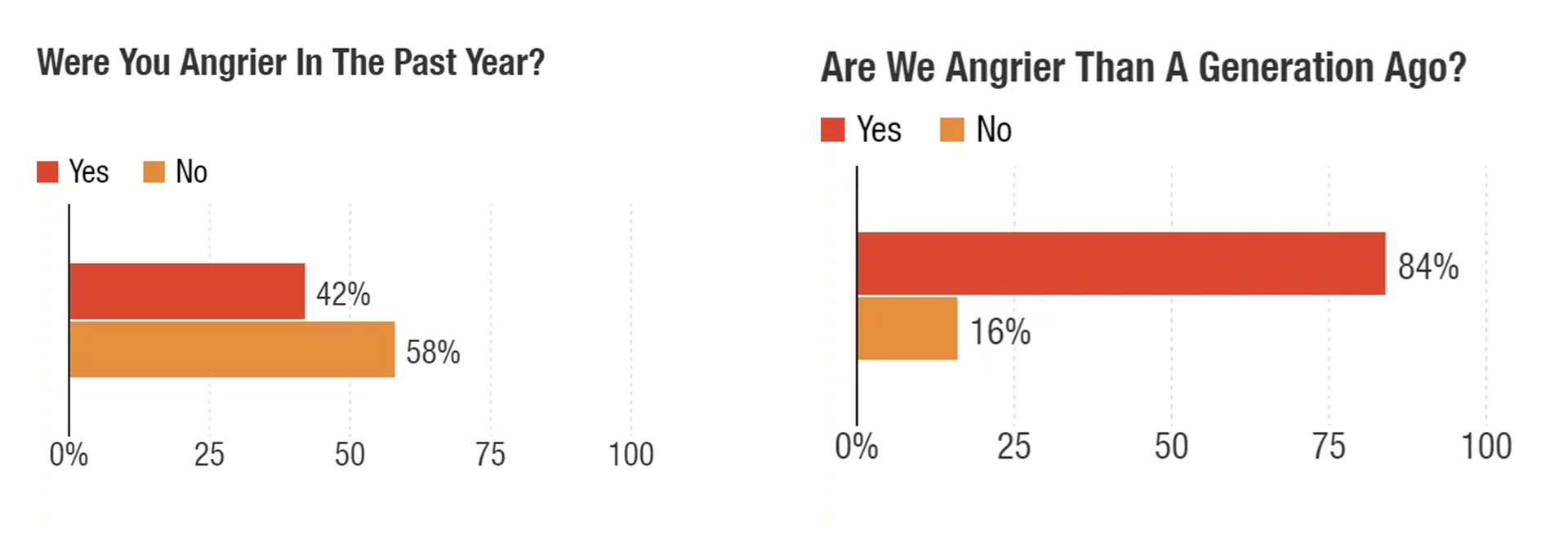
Expressing outrage has become a national pastime. A poll found that 84% of people think people are angrier today compared with a generation ago, and 42% said they themselves were angrier than they used to be.

Source: NPR-IBM Watson Health Poll

In a recent Substack, I wrote about Abraham Lincoln’s famous strategy for managing anger. Whenever his feathers were ruffled, he would write a “hot letter” to the person who had upset him but never send it. A study published in Scientific Reports in Nature just last week by researchers at Nagoya University confirms that Honest Abe was onto something.

Write it Down, Toss it Away 

Participants in the study were asked to write brief opinions about a social issue, such as whether smoking in public should be banned. They were then told that their writing would be evaluated by a doctoral student. In reality, there were no doctoral students. Regardless of what participants wrote, they received low scores on all measures including intelligence, interest, friendliness, logic, and rationality. To add insult to injury, included in the feedback were obnoxious comments such as “I cannot believe an educated person would think like this. I hope this person learns something while at the university.”

After receiving the low scores and harsh comments, participants were asked to write their feelings down on a piece of paper. As expected, all participants were incensed. Half the group was told to keep their written response on their desk while the other half was asked to crumple the paper into a ball and toss it into the trash. Both groups were then asked to rate their anger. Those who threw out the piece of paper reported no longer feeling angry whereas those who held onto it also held onto their anger.  A second similar experiment found that shredding the note with the angry thoughts also neutralized it.

The findings suggest that the simple act of physically discarding one’s negative sentiments is a powerful anger management tool.

“We expected that our method would suppress anger to some extent,” lead researcher Nobuyuki Kawai said. “However, we were amazed that anger was eliminated almost entirely.” 

Thankfully, for the sake of history, Abraham Lincoln did not fully dispose of his hot letters. Burying them in a file in a desk drawer was his way of discarding his fury and moving on. While his method may not have been quite as effective as crumpling the letters into a ball and tossing them into the garbage or shredding them, Lincoln chose to keep his fury to himself.

Choose Calm

As this research shows, we are not at the mercy of our emotions. “Big feelings” as people like to call intense bursts of emotion these days, need not dictate every action unless, of course, you are a toddler. While imperfect, we have choices. We have agency. We have tools. As Dr. Aliza Pressman, my friend and best selling author of The Five Principles of Parenting, likes to say, “All feelings are welcome, all behaviors are not!” 

While there is no doubt that social contagion can amplify feelings such as anger, a Stanford study found that people’s motivations are a driving force behind how much they allow others to influence them. According to their research, when people want to stay calm, they remain relatively unfazed by angry people but when they want to feel angry, then they soak up other people’s anger.

“The degree to which people said they were motivated to feel or not feel certain emotions predicted how much they would be influenced when they were exposed to emotions from other group members,” said Amit Goldenberg, the lead author on the study. Put simply, our emotions aren’t passive or automatic. We have a say in how we feel and subsequently behave. As Eleanor Roosevelt famously said, “No one can make you feel inferior without your consent.” We are participants in, not witnesses to, our emotional lives.  

Breathe, Don’t Vent 

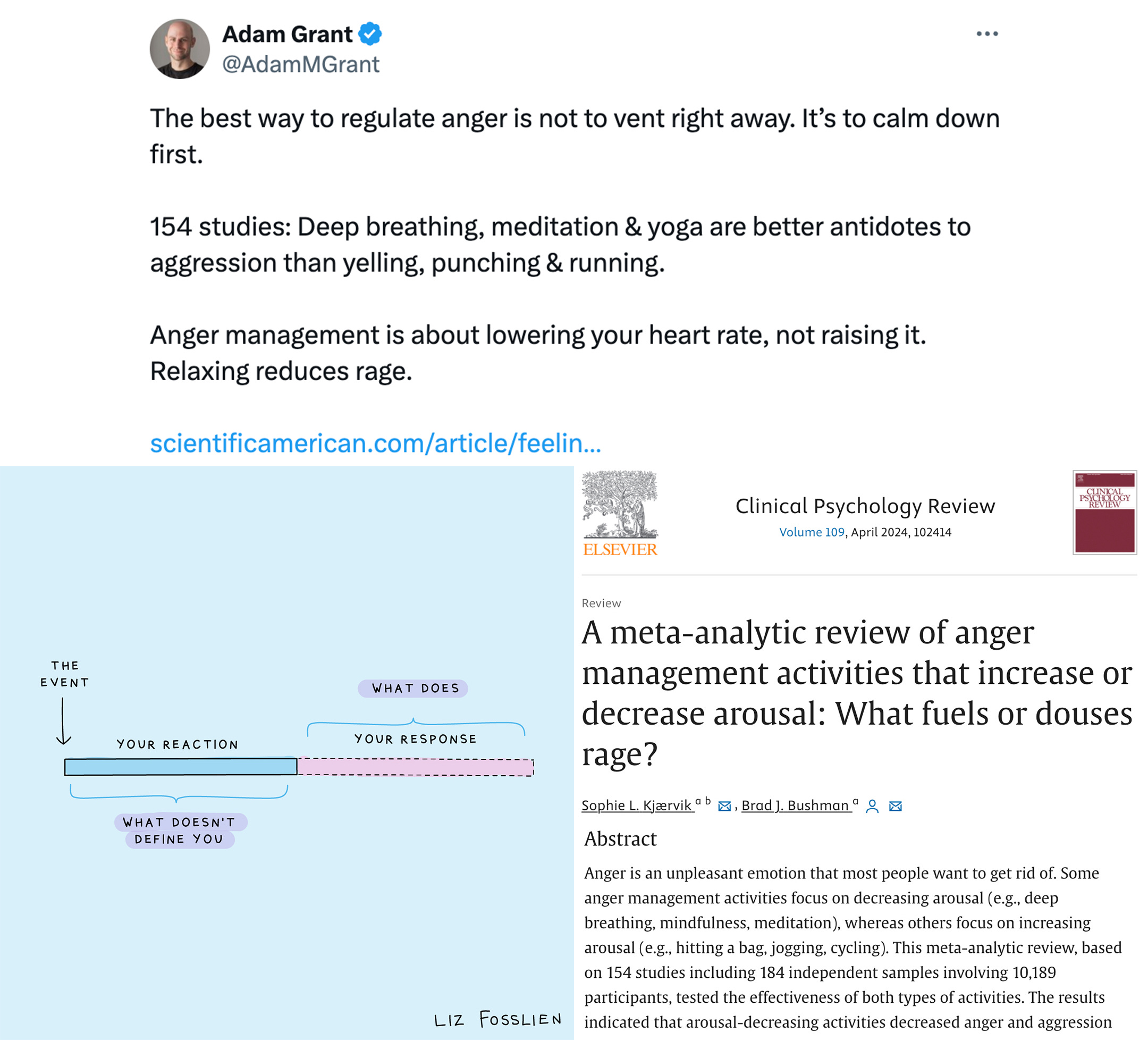
Conventional wisdom holds that blowing off steam is one of the best ways to reduce anger. This is a myth. Venting, punching a bag, or screaming into a pillow dials up physiological arousal which amplifies anger. Similarly, going for a run, cycling and boxing are good exercises but also dial up physical sensations associated with rage. A review of 154 studies found that activities that dial down physiological arousal such as deep breathing, yoga and meditation are far better antidotes for anger.

Image via X: @AdamMGrant

Anger is natural. How we respond to it is what matters. The parable of the Two Wolves comes to mind:

The grandmother tells her granddaughter, “Inside of all of us is a battle between two wolves. One is the dark wolf. It is anger, jealousy, regret, greed, arrogance, and resentment.

The other wolf is good. It is love, peace, hope, kindness, serenity, compassion, faith and empathy.

The granddaughter thinks about this for a minute and then asks her grandmother, “Which wolf wins?”

And the grandmother replies, “The one you feed.”

What I love about this story is how it captures the importance of our actions, agency, and attention. Every single day we have opportunities to feed the good wolf or indulge the bad one. It’s up to us which one we choose to nourish.

I wish you all the best,

Dr. Samantha Boardman

The Benefit of Keeping Your Feelings to Yourself

Whenever Abraham Lincoln felt the need to give someone a piece of his mind, he would fire off a harsh letter. Putting pen to paper was his way of unloading his fury. A classic example is the scathing note he penned to General George C. Meade, who he blamed for failing to capture Robert E. Lee at Gettysburg.

Lincoln was “distressed immeasurably” by Meade’s failure but Meade never learned of Lincoln’s immeasurable distress. Instead, Lincoln put the note in a drawer with the label “Never sent. Never signed.” He made a habit of writing “hot letters” but never sending them. It was a way for him to deal with his rage but without the carnage that accompanies spewing unprocessed vitriol. As Maria Konnikova wrote, these unsent angry letters served “as a type of emotional catharsis, a way to let it all out without the repercussions of true engagement.”

The Art of the Active Pause

Learning about Lincoln’s habit is a stark reminder of the value of reflecting on rather than reacting to our emotions. Contrary to cultural pressure to express ourselves, sitting on what is bothering us can act as an emotional windshield wiper, clearing the screen and providing a sharper perspective. In the heat of the moment, it is hard to know the difference between what is urgent versus what is important. As one patient said to me, “Everything Everywhere All at Once could be the title of my life.” Finding ways to press pause and override the itch to react is good for us and good for our relationships.

The impulse to lash out can feel like an imperative–especially with popular TikTok therapists reminding us to always “feel your feelings” and to say what we feel. Plus, with a “send” button at our fingertips, there is little friction between putting our feelings in writing and sending our thoughts out into the world. With an actual letter, finding an envelope and address, plus getting a stamp all take time and time can be a godsend.

It never fails to surprise me how much emotions shift over the course of a week, an hour, or even a night. As the old saying goes, “Everything looks better in the morning.” A patient with a standing appointment on Tuesdays afternoons often tells me how something distressing happens soon after our session–an argument with her partner on Tuesday evening or an issue with a coworker on Wednesday morning–and she has an impulse to tell me about it. But by the time our appointment rolls around a week later, the incident no longer occupies center stage. Whatever felt so earthshaking at the time feels like a minor tremor seven days on.

One of the marketing tools of therapy apps is how quickly the therapist responds. Some even offer unlimited 24/7 messaging. Other than in an emergency situation, I am not convinced that having a therapist at one’s fingertips is productive. It deprives the individual of the opportunity to sit on their emotions or even work through the situation on their own. Counter to the questionable advice that masquerades as therapy on social media, waiting it out and not reacting to or listening to one’s feelings is often a better strategy. Not every heated emotional situation is a 5-alarm fire requiring attention or expression or professional intervention. Maybe emotions are getting a little too much airtime in our daily lives. As psychologist Adam Grant pointed out recently on X, feelings are nothing but “emotional signals in the brain.”  It is possible that spending less time thinking about how we’re feeling might help us feel better.

There is evidence that the most effective way to deal with our emotions is to take a step back from them. If composing an email but not pressing the send button proves too tempting, consider some other science-backed strategies that might help you gain some perspective such as pretending to be a fly on the wall, or considering what you would tell a friend in the exact same situation, or imagining how you will feel about whatever is going on six months from now. Like writing a letter but never sending it, these self-distancing techniques invite us to step outside of our immediate experience and whirlwind of swirling emotions.

Speaking of swirling emotions, a favorite strategy of therapists who work a lot with teens is to ask them to vigorously shake up a snow globe and then watch the glitter settle. The analogy is clear–their brain is like a churned up glitter jar–all cloudy and hard to see through–but with time, the glitter will fall to the ground and everything will be clearer.

Maybe Lincoln would have enjoyed a glitter jar too.

I wish you all the best,

Dr. Samantha Boardman

The Problem With Labeling People as ‘Toxic’

Toxic is a word that gets thrown around a lot these days. As a psychiatrist, I hear it frequently during therapy sessions—to describe parents, siblings, neighbors, exes and co-workers.

Once primarily used to describe plants, arrows and chemicals, toxic—which is defined as “poisonous”—only recently started being applied to people. Self-help books and Britney Spears’s hit song certainly contributed to its journey from the literal to the metaphorical. In 2018, Oxford Dictionaries chose it as the word of the year. Social media is full of tips on how to spot a toxic person.

Toxic people are typically characterized as those who drain energy, create stress and who love to criticize. And that’s the problem: There is no room for nuance or context, even though most of us, at times, have been guilty of that exact same behavior. More than a description, labeling someone as toxic becomes a diagnosis of an untreatable condition, an irreversible defect. Once toxic, always toxic.

Inhibits understanding

Creating categories is useful when it helps the brain sort through the vast stimuli of everyday life. Every time we encounter a waist-high object with a flat surface and legs, for example, we can assume it’s some sort of table. This saves time and energy. But the tendency to categorize people can lead to reductionist assessments that inhibit understanding, reduce empathy and crush communication.

Referring to someone as toxic provides an excuse to distance ourselves from them. If they are toxic, we are justified in ignoring, avoiding and disengaging from them. No doubt there are people in this world whose behavior is deeply problematic and harmful such as in cases involving violence and abuse. In those situations, the healthiest response is to cut the person out. What concerns me is how casually “toxic” is used today to refer to anyone with whom we disagree or who falls short of our expectations.

When we divide the world into toxic and nontoxic people, we fall into a cognitive trap known as “all or nothing” thinking. If someone is toxic, there is no point in having a discussion with them. Why bother trying to understand where they are coming from or what might be going on in their life if they are flawed at the core?

Once placed in the toxic box, there is no space for compromise with them or curiosity about them. Rather than thinking, “That’s my exasperating uncle who has some beliefs I completely disagree with but who has some redeeming qualities too,” the go-to reaction is, “I’m done with this person.” In our certainty of their toxicity, we risk losing sight of their humanity.

Don’t stop talking

In my practice, there is a lot of therapy-speak around severing ties with so-called toxic people. Setting boundaries often translates into ceasing communication. But when we stop talking, we rob ourselves of the potential of repair and erase the possibility of a relationship.

A patient once explained to me during an initial evaluation, “The way I see it, people are either with me or against me.” When I responded that her treatment would involve learning to question knee-jerk responses and to resist the impulse to dismiss or judge, she decided I wasn’t the right psychiatrist for her.

“Isn’t it the psychiatrist’s job to be on the same team as the patient?” she asked.

The psychiatrist’s job, I explained, was to encourage a patient to appreciate complexity, to strive for understanding and to discourage the viewing of life through an “us and them” prism.

From the moment we label someone as toxic, though, all subsequent interactions are interpreted through an uncharitable lens and seen as further confirmation that the person is, in fact, toxic. Ambiguous situations become crystal clear. When a co-worker my patient had deemed to be toxic sent a departmentwide email suggesting a different interview process for future employees, my patient became convinced that it was criticism directed at her as she was a relatively new hire. While that was certainly possible, I pointed out that it also was possible that her co-worker had other motivations.

Other explanations

I advise patients to search for information that contradicts their knee-jerk response and to challenge the impulse to label someone as toxic. Are there other explanations for the person’s actions? Is this a blip or a pattern? Abusive behavior is vastly different from someone who says something that is unintentionally offensive. There is evidence that learning to give people the benefit of the doubt not only makes us less quick to judge but can also make us happier.

In one study, three groups were given unpleasant electric shocks administered by a partner. The first group was told that the shock was delivered by accident and outside their partner’s awareness. The second group was told that they were being shocked intentionally, but for no particular reason. The third group was told that they were being shocked because their partner was trying to help them win lottery tickets. Those in this third group reported significantly less pain than those in the other two groups. Simply believing that someone had good intentions and was trying to help them lessened the pain.

Bottom line

While it is naive to believe that everyone’s intentions are noble, it might be worth at least considering the “why” behind the “what.” I have yet to hear anyone refer to their child or pet as toxic. I suspect they get a pass because we believe in their good intentions and that they are more than their missteps.

I wish you all the best,

Dr. Samantha Boardman
Forget Work-Life Balance

Have you ever met someone who has actually achieved work-life balance? I haven’t. As Oliver Burkeman wrote in the best-selling book Four Thousand Weeks: Time Management for Mortals:

“Nobody in the history of humanity has ever achieved ‘work-life balance,’ whatever that might be and you certainly won’t get there by copying the ‘six things successful people do before 7 a.m.’”

Rather than striving for optimal time management, he advises us to make peace with the reality that there will never be enough time to do all the things we would like to do. Put simply, he argues, it’s time (pun intended) to give up the fight against time because it’s a lost cause:

“No finite human being has ever won a fight against time. We just get the limited time we get, and the limited control over it that we get. And if you spend your life fighting the truth of this situation, all that happens is that you feel more rushed and overwhelmed and impatient – until one day time decisively wins the fight, as it was always destined to do. (In other words: you die.)”

In a world filled with productivity porn, Burkeman’s perspective is refreshing. Instead of trying in vain to cram more tasks into each day and get more done, perhaps making better use of the limited time that we have is a better strategy.

Here are 7 ways to feel less frazzled:

Be a Reductionist 

Whenever we encounter a problem, we almost always tend to add something. This is known as subtraction neglect. We add meetings to address issues at work, we add homework to improve academic performance, we add apps to boost efficiency, we add products to enhance skin, but rarely consider how the alternative could be transformative. What can you do less of?

Be Wherever Your Feet Are

I heard this excellent advice a few months ago. It’s a wonderful reminder to give your full attention to the moment you are in and to the person you are with.

Be Still 

Press pause regularly. Rather than packing more work into a given day, take some time to reflect on the lessons of the day.

Be Helpful 

A counterintuitive way to feel less pressed for time is to give it away. Volunteering and doing things for others, rather than focusing on ourselves, expands our sense of time and meaning.

Be Selective

Say no to things that don’t align with your values. Guilt and obligation are not reasons to give your time away.

Be Honest

Many people say they wish they could spend more time with their family but end up on their phones whenever they are with them. Quality face time with loved ones is a vital contributor to wellbeing. Nobody on their deathbed ever said, “I wish I had spent more time on social media.”

Be a Sleep Enthusiast

Lack of sleep is a vampire of vitality. Mental and physical energy are a fundamental currency of wellbeing. Quality time is enhanced by quality sleep.

Bottom Line

Let go of striving for that elusive ideal of work-life balance and spend your precious time doing things that matter. Sometimes that will throw you off balance and that’s okay. As  Alain de Botton observed, “Everything worth fighting for unbalances your life.”

I wish you all the best,

Dr. Samantha Boardman